Марта Довга
06.12.2025
Share:


Time to reading: min

Every piece of writing — whether it’s a thesis, research paper, article, story, or essay — must have a clear structure. Even a short blog post or Instagram caption follows a certain order. It’s simply necessary if you want your text to be readable. And this is especially true for essays.
Unlike many other academic assignments, the essay offers much more freedom. But with that freedom comes responsibility. Just because you’re allowed to shape the essay yourself doesn’t mean you can neglect its structure — it simply means you’re now responsible for constructing it thoughtfully.
You can imagine the structure in your head, but it’s far more effective to jot down a rough outline on paper. A plan is the skeleton of the text — the framework that supports your core content. Any piece of writing needs a plan, and an essay most of all.
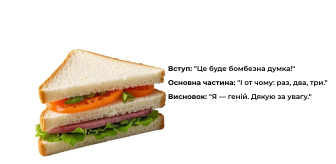
Any written work consists of three main parts: introduction, body, and conclusion. In some academic papers, you might also find a table of contents, bibliography, or abstract — but essays typically do not include these extras.
The introduction is usually considered the first paragraph (or two) of the essay. While not formally required, it’s logical to begin by smoothly guiding the reader into the topic and introducing the central problem. A long introduction is unnecessary — one or two paragraphs are enough.
This is the core of the essay and should receive the most attention when outlining. There are several ways to structure it:
Thesis → Argument → Thesis → Argument, etc.
You start with a statement (thesis), then support it with reasoning or evidence.
Reverse order — present facts or a situation first, and then draw a conclusion. This cycle may repeat several times.
One thesis + multiple arguments, where a single idea is supported by various examples.
A thesis is a concise, complete idea that the author wants to convey. An argument is the proof: a real-life example, a news story, expert opinion, scientific theory, or verified fact.
Ideally, one thesis is supported by two arguments. One may feel weak, and three or more might overwhelm the reader. However, the exact number should align with your intention, logic, essay length, and style. The key is maintaining clarity, coherence, and expressiveness.
The conclusion summarizes everything stated in the essay. The author reflects on the discussion and highlights the key thoughts or hypotheses, possibly reinforcing them with a relevant quote. It’s essential that the conclusions are not artificial or disconnected from the content — they must arise naturally from the main body.
Only draw conclusions that logically follow from the material presented. Avoid surprising the reader with statements that weren’t developed earlier in the text.
Let’s be clear: most tips about writing essays are general guidelines. A formulaic approach is exactly what you should avoid in this creative genre.
1. Read other essays.
This helps you develop your own style. Essays are not dictations; they are a form of personal expression that requires a sense of tone and rhythm. Experts say a good essay often feels emotional, expressive, and stylistically rich.
2. Prepare thoroughly.
Study the topic, reflect on what you’ve read, and talk about it with others. An essay is a creative reflection on a specific issue. Write for an audience that understands the topic — otherwise, you risk drowning in irrelevant details. Formulate your theses and arguments and arrange them meaningfully.
3. Plan your structure.
There are few formal rules — the title is usually the only requirement. A common structure includes: title, introduction, theses with arguments, conclusion, and (optionally) a bibliography. For journalistic or literary essays, you don’t need a reference list. If anything is essential in essay content, it’s the thesis and argument.
4. Avoid overloading the text.
Brevity is the soul of wit. While everyone has their own style, overly long and complex sentences full of literary devices may turn readers away.
5. Be sincere.
Don’t invent or steal other people’s ideas, hypotheses, or quotes. Write naturally. Use words that are familiar and accessible to both you and your readers — this builds authenticity and trust.
Final Thought
The essay is a creative genre, not bound by rigid rules. You’ll have to rely mostly on yourself — your intellect, knowledge, and ability to communicate in writing.
Good luck!
0.0/5
(0 оцінок)
56 перегляди
Курсова робота
Тези
Дипломна робота
Контрольна робота
Реферат
Есе
Щоденник з практики
Магістерська робота
Бакалаврська робота
Вирішення задач
Мотиваційний лист
Лабораторна робота
Самостійна робота
Звіти з практики
МАН
 Terrible
 Badly
Badly
 Fine
Fine
 Good
Good
 Excellent