Марта Довга
06.12.2025
Share:


Time to reading: min

Hello, students!
Some of you have already had the experience of writing a scientific article, term paper or thesis. For some, this process is still ahead. But it is unlikely to be 100% bypassed. However, do not be afraid! Take our advice and feel free to dive into the process.
The purpose of writing a term paper usually consists in consolidating the student’s knowledge for the completed course, obtained during the educational process on a certain subject. Thanks to such work, it is easier for the teacher to check the quality of the student’s knowledge and the ability to apply this knowledge in practice.
The standards of coursework are usually the same, but there may be slight differences in different educational institutions. This must be taken into account if you plan to order a term paper and not write it yourself.
Would you like to know some tips for writing a course project? So, let’s get started:
Step 1: Theme and outline
“You need to choose a topic and outline a plan – as if everything is simple,” students think, but it is not so. Coursework topics are approved by the department and announced to students. Each student can choose a topic that matches his interests and capabilities. It happens that topics are distributed on a list without the right to choose, but you can always try to agree to replace the topic if you don’t like it at all.
The first thing you need to do, when you have received the topic of the coursework, is to choose reference literature and make a plan.
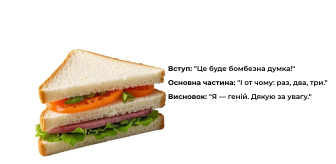
The plan must comply with the generally accepted structure:
– introduction;
– main part;
– conclusions;
– list of sources;
– applications.
Advice: be sure to approach the supervisor with a plan and a list of references about 2 weeks after receiving the course topic, demonstrate your sincere interest and adequacy. A normal teacher will appreciate your desire to delve into writing a paper and will give you his recommendations.
Step 2: Looking for information
You will probably think: ‘well, the theory, I found it quickly on the Internet, awarded a bunch of everything, deleted the excess and finished’, but no…
So, when the plan is approved by the supervisor, and some of the literature, the teacher will still advise you. What now – with your head in a whirlpool of information? But you can drown there (or, on the contrary, wander for a long time in search of materials on a topic on which almost no one has written anything). First, review the plan to get an idea of what information you need to look for.
1) Use of electronic resources. Every day, each of us uses the Internet (some kind of addiction even), in it you can find unreal deposits of information on various topics, and especially there is such an interesting material that your term paper will become “candy”. Remember: Copied information should be paraphrased as much as possible.
2) Libraries and archives. Of course, many of you will say that the library is the last century, but unfortunately, not all books and magazines can be found online. For example, due to the fight against piracy, some new books can only be bought. And the old ones may not be digitized yet. So for someone, a trip to the library will be a salvation, besides, I will tell you a secret, the atmosphere there inspires writing.
Step 3: The practical part
If you are a creative person, then you are lucky, because it will be easier to write the practical part. There is no algorithm as such for this section, it is still aimed at your creativity, but do not think: “and if I am a teacher, it will be difficult for me?”, no, of course, your skills and best sides can be applied everywhere.
Step 4: Introduction and Conclusions
Yes, these parts of the course work are written last. It is clear with the conclusions, but why should the introduction also be written at the very end? And because when writing the coursework (and especially when working on the practical part) your hypothesis can be disproved, since the introduction contains all the information from all sections. And since the course can be adjusted several times, it makes no sense to write an introduction right away.
Anyone who wants to write a term paper with “excellence” must consider and analyze the material. Each paragraph and each section should end with a personal conclusion on the topic. Therefore, in the conclusions, it is necessary to refute or confirm the proposed hypothesis, as well as to mention the prospect of further study of the topic.
The introduction and conclusions are the first things teachers read. An uninteresting introduction increases the chances that your work will not be appreciated. So try to give this part of the course as much time as possible.
Step 5: Designing applications and sources
In order to correctly design the list of references, usually this is the most often criticized, it should be remembered that a manual is attached to each term paper, in which all the design rules are written. References and footnotes, as well as the design of appendices, i.e. tables/graphs and diagrams. I think that during the years of study, you still learned how to make page footnotes and correctly [..] put links, and if not, you can find this information in the coursework requirements.
So, to summarize, writing a term paper is quite a long and painstaking process. However, as you gain experience, you will understand better and this process will take you less and less time. However, you shouldn’t put off writing the coursework until the last day.
If these 5 steps on the way to the perfect job seem too difficult for you, you can order a job from us on the website. But keep in mind that in order to get a high grade, you will still have to see the supervisor several times.
No fluff, no feather!
High fives to all!)
0.0/5
(0 оцінок)
80 перегляди
Курсова робота
Тези
Дипломна робота
Контрольна робота
Реферат
Есе
Щоденник з практики
Магістерська робота
Бакалаврська робота
Вирішення задач
Мотиваційний лист
Лабораторна робота
Самостійна робота
Звіти з практики
МАН
 Terrible
 Badly
Badly
 Fine
Fine
 Good
Good
 Excellent